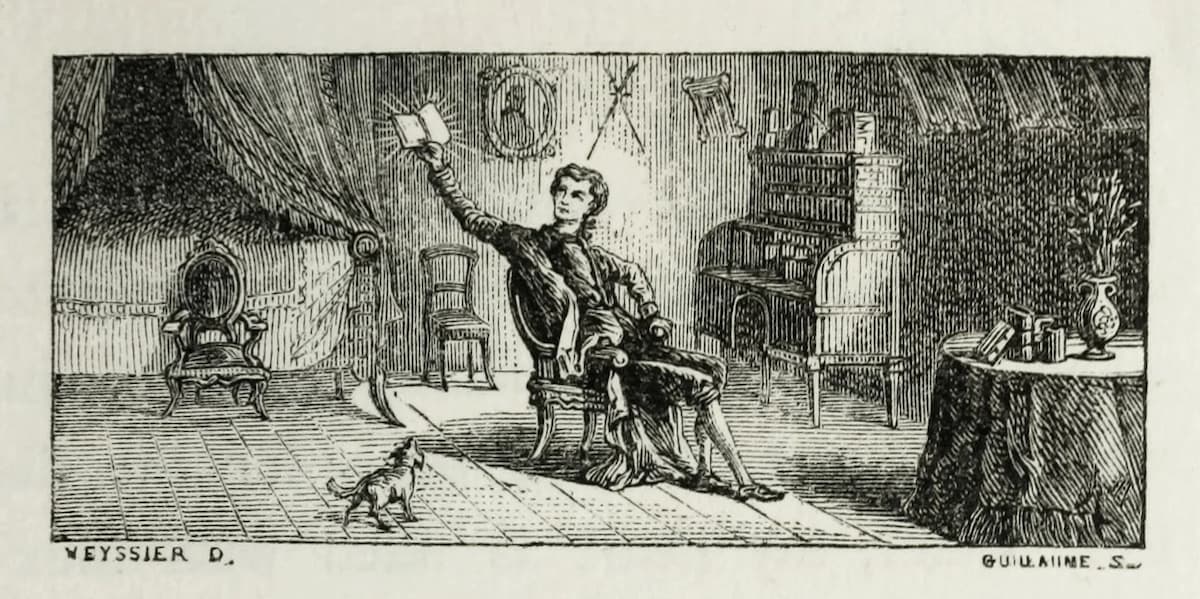
Xavier de Maistre in an armchair, displaying his “book of discoveries” (Veyssier, 1860)
Every so often I like to include a public domain image in a blog post. I’m fond of the woodblock and lithographic illustrations of the late 1800s. I try to avoid indiscriminately (un-)splashing every post but the real reason for the infrequency isn’t radical self-control, it’s because dumpster diving for public domain images can be a chore.
You can –of course– use Google or Bing to find public domain images but the volume, duplicates, and weighing the veracity of copyright attribution is overwhelming. The Library of Congress has Free to Use and Reuse sets, but their collections are nebulous noun buckets filled with a federally-mandated amount of Americana. On top of that, searching library sites is never a good experience to me. They tend to be slow and inaccurate with poor quality results and it’s a matter of time until you’re redirected to a smaller local library collection or database that’s even less maintained.
That’s why –for me– a little for-profit curation goes a long way. I wrote down some of my favorite resources from my last search (so I can remember next time) and will try to keep a running list of good resources I find.
- The Public Domain Review writes blog posts about interesting works and curates quality finds in the Public Domain Image Gallery. Notably, The PBR has a cool “Infinite View” way to browse. It’s a bit overwhelming for me, but you may love it.
- Artvee is a site with some great curation of public domain images.
- Heritage Type maintains some nice collections of vintage illustrations , almost like tattoo flash art in PNG and vector formats.
The business models are similar; pair the public domain with something to sell. The Public Domain Review and Artvee sell prints, aprons, or coffee mugs of the public domain works while Heritage Type funnels you to their quality fonts and design assets. I know we all hate Capitalism, but taking a small cut off the top for quality curation seems like a good trade and not an abuse of the commons.
Blessed are the curators.